

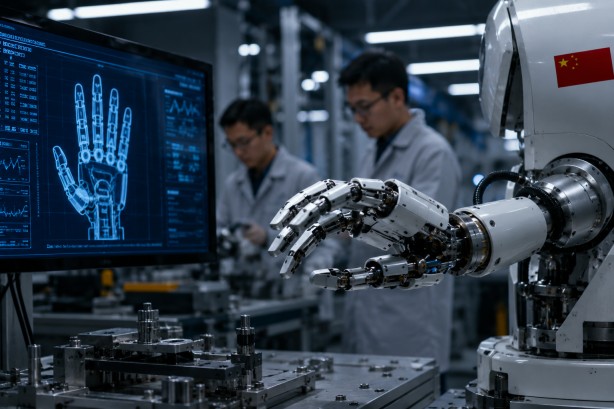
Chinese robotics companies are accelerating their efforts to master the creation of dexterous robotic hands, which are seen as a pivotal development in the evolution of humanoid robots. These companies are leveraging artificial intelligence and China’s robust manufacturing sector to engineer robotic hands capable of executing intricate tasks such as object manipulation, tool usage, and performing daily functions. This technology holds significant promise for enhancing the practicality of humanoid robots in domestic, healthcare, and industrial settings.
According to experts, replicating the human hand’s dexterity and precision poses a far greater challenge than constructing other parts of a humanoid robot. Developers face hurdles in both hardware and software domains, needing to design compact motors and sensors while also creating programs that allow robots to interpret touch, pressure, and execute complex movements. Overcoming these challenges is critical to advancing robotic capabilities.
With its advanced supply chain and governmental support for “embodied AI,” China has positioned itself as a global leader in the field of robotics manufacturing. The nation’s burgeoning robotics ecosystem is fueling innovation at a rapid pace. Companies within this ecosystem are developing sophisticated robotic hands, sensor gloves, and AI systems designed to learn human movements through data gathered from real-world interactions.
Researchers emphasize that enhancing the dexterity of robotic hands is essential for robots to perform a diverse array of everyday tasks, spanning household duties, industrial applications, and even advanced prosthetic developments. This focus on improving robotic hand functionality is seen as a crucial step toward broader applications and integration of humanoid robots across various sectors.
Industry leaders anticipate that continued advancements in AI and robotics could lead to humanoid robots interacting more naturally with humans. Such progress could unlock new opportunities in manufacturing, healthcare, and consumer services, fundamentally changing how robots are utilized alongside people in various aspects of life.