

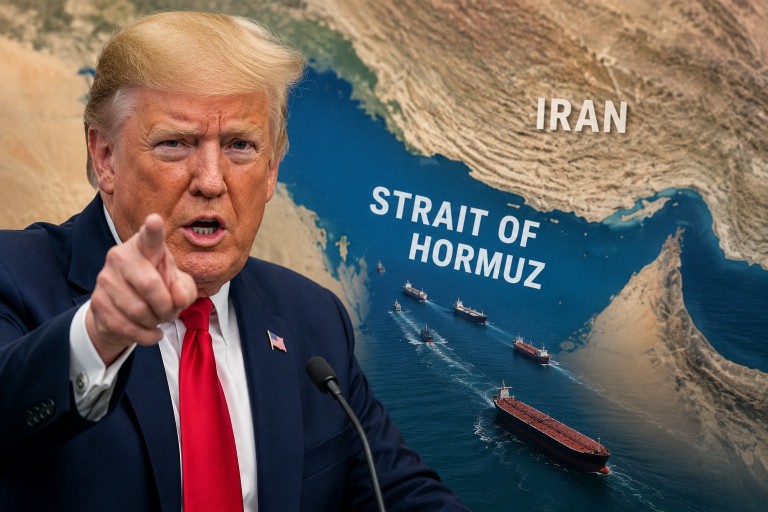
President Donald Trump has indicated a potential move to declare the Strait of Hormuz as “a territory of the United States,” amidst ongoing tensions with Iran. Speaking in New York on Friday, Trump suggested that this declaration could occur “pretty soon” following a victory over Iran, asserting that the U.S. already exerts control over the vital maritime passage through a blockade.
The Strait of Hormuz holds significant strategic importance as it facilitates approximately one-fifth of the world’s seaborne oil transport. Situated between Iran and Oman, this crucial waterway has been largely inaccessible since military actions by the U.S. and Israel against Iran commenced. It remains uncertain whether Trump’s remarks signal an official shift in U.S. policy or serve merely as a political maneuver.
In response, Iran has dismissed the threat. Kazem Gharibabadi, Iran’s Deputy Foreign Minister, stated that Tehran would not be swayed by U.S. pressure, emphasizing that decisions regarding the opening or closing of the strait reside with Iran. Moreover, Iranian Foreign Minister Abbas Araqchi confirmed that Tehran had not yet opted to resume negotiations with Washington, noting that the exchanges through Qatar and Pakistan do not amount to formal discussions.
Iran has laid out several prerequisites for reopening the strait to shipping, including compensation for damages incurred during the conflict, the removal of sanctions, and the release of frozen Iranian assets. The ongoing conflict and resulting disruption in shipping have driven up fuel prices, creating additional challenges for consumers. President Trump defended the elevated prices, arguing that they reflect the cost of preventing Iran from acquiring nuclear weapons.
The stalemate concerning the Strait of Hormuz has heightened anxieties about the security of global energy supplies and the broader economic repercussions of the conflict. As the situation remains unresolved, the international community continues to watch closely, aware of the potential impacts on global markets and geopolitical stability.