

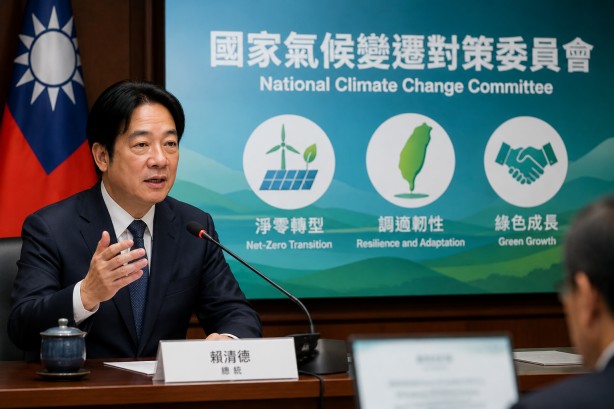
At a recent gathering of the National Climate Change Committee, Taiwan President Lai Ching-te laid out a comprehensive plan to enhance the nation’s approach to climate change, focusing on three fundamental strategies: fostering greater social involvement, ensuring energy stability, and safeguarding the nation’s land. Emphasizing the growing complexity and frequency of climate risks, Lai articulated the government’s commitment to boosting food security, achieving greater energy independence, and reinforcing disaster prevention and public health measures. He stressed that effective climate governance should permeate beyond governmental policies and become ingrained in daily life and community practices.
In an effort to boost public engagement, the government is promoting an ambitious urban forest initiative across the nation. This involves the creation of a national Urban Forest Promotion Committee and the organization of 50 local forums designed to gather community feedback before finalizing a nationwide urban forest strategy later in the year.
Lai also highlighted Taiwan’s achievements in offshore wind power as part of the country’s energy strategy. With 508 offshore wind turbines producing a total of 4.9 gigawatts, Taiwan is positioning itself as a leader in the global offshore wind market. Moving forward, the country aims to expand its renewable energy portfolio, fortify its power grid, enhance energy storage capabilities, and develop local supply chains, all while maintaining a balance with environmental sustainability.
The preservation of natural resources such as forests, farmland, rivers, wetlands, coastlines, and marine ecosystems is another key priority laid out by Lai. These efforts are crucial to strengthening the island’s resilience against extreme weather events, flooding, rising sea levels, and disruptions in agriculture. Climate adaptation strategies will be integrated into land-use planning and agricultural policies, ensuring Taiwan’s climate initiatives align with international environmental standards.
During the meeting, various government departments, including the Ministry of Environment, Ministry of Agriculture, Ocean Affairs Council, and Ministry of Economic Affairs, delivered reports detailing efforts in environmental education, sustainable agriculture, ecosystem conservation, and the long-term development strategy for offshore wind power in Taiwan. These presentations underscored the multi-faceted approach the nation is taking to confront climate change and its associated challenges.
Legal Disclaimer: The information contained in this article has been provided by independent third-party contributors, clients, or content partners. We do not independently verify the accuracy, completeness, legality, ownership, licensing, or reliability of submitted content, including text, images, videos, trademarks, or other media materials. The submitting party is solely responsible for ensuring that all content, including images and media assets, complies with applicable copyright, trademark, licensing, and intellectual property laws. We disclaim liability for any unauthorized use of copyrighted or proprietary materials by third parties. If you believe that any content published on this platform infringes your intellectual property rights, kindly contact the author above for prompt review and resolution.